
Global Minimum Tax
Overview and Technical Aspects
Contents
2. THE CONTEXT OF MINIMUM TAXATION.. 3
4.1 Extra Profit – Taxable income (denominator of the ETR ratio) 8
4.2 Adjusted covered taxes (numerator of the ETR ratio) 11
5.1 Transitional Safe Harbours. 14
5.3 Countries that have adopted the QDMTT and the QDMTT SH.. 17
Qualified Income Inclusion Rules. 17
Qualified Domestic Minimum Top-up Tax Rules and QDMTT Safe Harbours. 20
6. REPORTING, PAYMENT AND ASSESSMENT OBLIGATIONS. 23
6.1 Notification of Designation to submit the Relevant Communication. 23
6.2 Relevant communication (GloBE Information Return or GIR) 24
6.3 Return, collection, assessment and penalties. 26
1. INTRODUCTION
This document has the sole purpose of providing an overall framework for the application of the Global Minimum Tax in Italy and therefore makes no claim to completeness.
In fact, the Global Minimum Tax (GMT) represents one of the most significant and complex tax initiatives of recent years, aimed the erosion of the taxable income and the transfer of profits by multinationals to low-tax jurisdictions.
The GMT was designed to ensure that multinational companies pay a minimum tax wherever they operate, thereby reducing tax avoidance practices and promoting greater fairness in the global tax system.
Consequently, as part of the European reform of international taxation, a Top-Up Tax has been introduced for large international groups with consolidated revenues equal to or exceeding 750 million euros and for large-scale national groups with revenues also equal to or exceeding 750 million euros (essentially the Groups subject to CbCR), for each State in which one of their entities is located, namely a supplementary tax to be determined by subtracting the Effective Tax Rate (ETR) from the agreed minimum level of taxation (equal to 15%) where the former is lower.
Taxation is implemented through rules defined at three levels:
- The Income Inclusion Rule (IIR), for which the liable party is the Parent Company, resident in a country adhering to GloBE, in respect of its subsidiaries in low-tax countries.
- The Undertaxed Payments Rule (UTPR), a safeguard rule to be applied where the former is not effective at the Parent Company level because it is resident in a country not adhering to GloBE, and applied to the subsidiaries (shifting GMT liability from the Parent Company to the European consolidated entities). And,
- The Qualifying Domestic-Minimum Top-Up Tax (TUT), payable by the resident Group companies to supplement their taxation up to the effective minimum level of 15%, where the taxation resulting from the application of domestic income taxes is lower (bearing in mind that the effective taxation is independent of the domestic nominal tax rate – in Italy’s case 27.9% – and is determined on the basis of a specific calculation relating to the taxable income).
The Italian Government implemented the legislation through Legislative Decree no. 209 of 27 December 2023 (hereinafter “LD”), in order to ensure a minimum level of taxation for multinational or national groups of companies, in line with the common approach agreed at the international level on the basis of the OECD rules adopted on 14 December 2021 “Tax Challenges Arising from the Digitalisation of the Economy – Global Anti-Base Erosion Model Rules (Pillar Two)” and the provisions of Council Directive (EU) 2022/2523 of 15 December 2022.
That Decree specifies that the provisions contained therein are interpreted and applied considering the Commentary to the OECD rules adopted on 11 March 2022 “Tax Challenges Arising from the Digitalisation of the Economy – Commentary to the Global Anti Base Erosion Model Rules (Pillar Two)”, as subsequently amended, and the Administrative Guidance envisaged in Article 8.3 of the aforementioned OECD rules.
The L.D. refers the issuance of the operational implementation rules of the new legislation to various ministerial decrees. To date, the following Ministerial Decrees have been issued:
- Ministerial Decree of 20 May 2024: Implementing provisions concerning simplified[1] transitional regimes, issued pursuant to Article 39 of the LD
- Ministerial Decree of 1 July 2024: Implementing provisions relating to the domestic minimum tax
- Ministerial Decree of 11 October 2024: Substance-based income exclusion (SBIE)
- Ministerial Decree of 20 December 2024: Various provisions concerning the Global minimum tax
- Ministerial Decree of 27 December 2024: Rules governing deferred taxation in the transitional period
- Ministerial Decree of 25 February 2025: Rules governing the notification obligations of the reporting entity[2]
- Provision of 7 August 2025: Approval of the notification form for identifying the entity required to submit the relevant communication, as referred to in Article 3 of the Decree of the Deputy Minister of Economy and Finance of 25 February 2025, and definition of the related submission procedures
- Ministerial Decree of 16 October 2025: Implementing provisions on disclosure obligations relating to the top-up tax and transposition of EU Directive 2025/872 of 14 April 2025 (Relevant Communication or GIR)[3]
- Guidelines of 31 October 2025: Guidelines of the Italian Revenue Agency for completion of the Relevant Communication (GIR)
- Ministerial Decree of 07 November 2025: Implementing provisions on reporting and payment obligations relating to the top-up tax (National return for GloBE)[4]
- Resolution no. 63/E of 10 November 2025: With this Resolution, the Italian Revenue Agency established the tax codes for payments relating to global minimum taxation via the F24 form
- Provision of 6 February 2026: Approval of the annual declaration form relating to the supplementary tax due as supplementary minimum tax, supplementary minimum tax and national minimum tax, pursuant to Article 53 of Legislative Decree no. 209 of 27 December 2023
2. THE CONTEXT OF MINIMUM TAXATION
The idea of a global minimum tax took shape in the context of international discussions on tax reform, particularly under the protection of OECD. The project forms part of the BEPS (Base Erosion and Profit Shifting) package of provisions, aimed at preventing companies from exploiting gaps and inconsistencies in international tax rules to reduce their tax burden.
The Global Minimum Tax provides that the effective tax rate (ETR) of each Group company must not be lower than 15% in each country in which they operate (this is therefore not a group average rate, but a rate for each individual country).
The application of the GMT operates at three levels of taxation:
- Top-up tax (Income Inclusion Rule, IIR): concerns Parent Companies resident in countries that have adopted the application of GloBE and that are required to apply a top-up tax in respect of foreign subsidiaries resident in countries with an effective tax rate (ETR) lower than 15%.
- Supplementary tax (Undertaxed Payment Rules, UTPR): where the parent company is resident in a country that has not adopted GloBE, its subsidiaries resident in countries that have adopted GloBE are jointly and severally liable for the supplementary tax due for those group companies resident in countries with a tax rate lower than 15%.
- Qualifying Domestic-Minimum Top-Up Tax (TUT): the majority of countries that have adopted GloBE, including Italy, also apply a top-up tax to corporate income taxes for companies located therein. In the case of Italy, where the effective taxation is lower than 15%, it would be necessary to include in the taxes due the effective rate through a specific calculation which in practice constitutes a third category of domestic tax for companies, distinct from IRES and IRAP.
The agreement on the Global Minimum Tax (“GMT”) is therefore governed by a set of hierarchically ordered instruments that ensure its levying through the Qualified Domestic Minimum Top Up Tax (“QDMTT”) and/or the Income Inclusion Rule (“IIR”), as well as, as a residual mechanism, through the Undertaxed Profit Rule (“UTPR”).
By virtue of these specific operating rules, in principle the agreement gives each individual jurisdiction the power to collect even the entire tax difference (Top-Up Tax or “TUT”) compared to the common minimum tax that has not been “recovered” elsewhere, committing all other jurisdictions to recognise that right (for example, under certain conditions Italian law could require a company resident in Italy to pay the top-up tax due by one of its affiliates resident in a low-tax country).
In fact, the GloBE Rules assign each country multiple levels of action, allowing it to:
- Directly collect – through the QDMTT option – the TUT relating to the group entities present in its territory. And also,
- Directly collect the TUT relating to all foreign group entities if the Parent Company, the Ultimate Parent Entity (“UPE”), is located in its territory. And finally,
- Participate – where the UPE is located in a country that has not implemented the common rules – in the allocation of the residual global TUT relating to all foreign entities without distinction (including the respective parent companies) through the UTPR, up to claiming the entire amount of the residual global TUT in the extreme case where none of the other jurisdictions in which the group operates has implemented the GloBE Rules. As stated, this takes place in a context in which the other jurisdictions have in any event undertaken to recognise the right of each country to operate in accordance with the relevant rules by signing the agreement.
Set out below are some illustrative examples of the application of the GMT, identifying the parent company as the UPE (Ultimate Parent Entity).
Example 1: UPE resident in a country adhering to the GMT with subsidiaries resident in Italy and in countries both adhering and not adhering to the GMT, or in any case not applying the QDMTT:
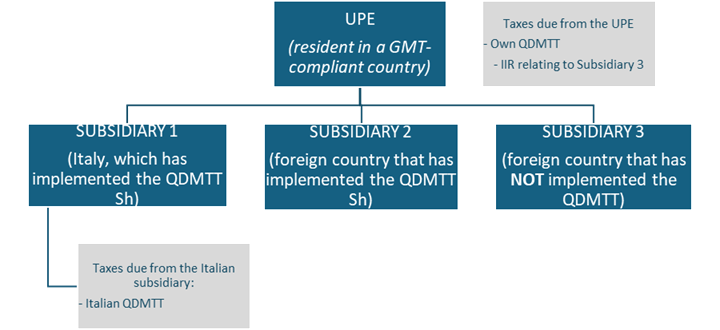
Figure 1 – UPE IN A GMT COUNTRY
The Italian subsidiary is solely responsible for its own QDMTT, i.e. for any difference between the minimum level of taxation, 15%, and its effective tax rate (ETR), if lower. Considering that the Italian nominal tax rate is 27.9%, the likelihood that the ETR of the Italian subsidiary is lower than 15% is low. The calculation of the effective tax rate also takes into account the effect of deferred and/or accrued taxes arising from temporary differences (regardless of their actual recognition).
The UPE, on the other hand, is responsible for both its own QDMTT and for the IIR, or top-up tax, due in its country of residence for any difference in taxation in the country of Subsidiary 3, given by the difference between the GMT and the effective ETR of Subsidiary 3, if lower than the GMT.
There are instead no implications for the UPE in terms of IIR with regard to Subsidiary 1 and Subsidiary 2, as both countries have adopted the application of the QDMTT Sh, thus integrating the effective taxation at least up to the minimum level of the GMT (15%).
There are likewise no implications for Subsidiary 1 and Subsidiary 2 for any difference between the GMT and the effective taxation in Subsidiary 3 since the UPE, being resident in a GMT-compliant country, is required to pay the top-up tax (IIR) to its tax administration, thereby in fact relieving Subsidiary 1 and Subsidiary 2 from any further taxation.
Example 2 The UPE is resident in a country NOT adhering to the GMT and has subsidiaries resident in Italy and in a country not adhering to the GMT or in any case not applying the QDMTT.
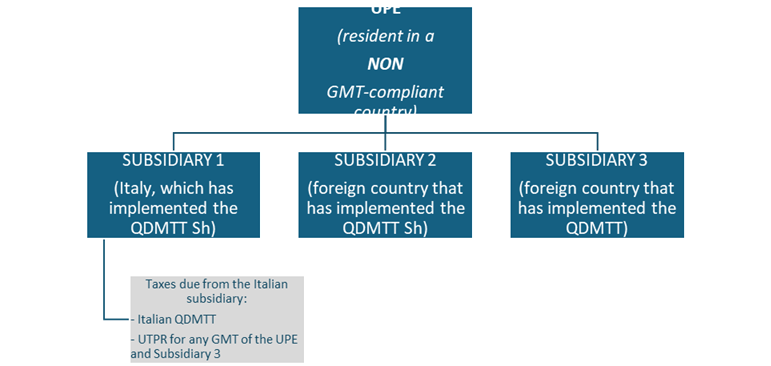
Figure 2 UPE IN A NON-GMT COUNTRY
In this case, the UPE, not being resident in a GMT-compliant country, is not required to pay any IIR potentially due from Subsidiary 3.
In such case, in addition to their own QDMTT, Subsidiary 1 and Subsidiary 2 will also be required to pay the supplementary UTPR tax for the portion attributable to the State of their residence. The total amount of the UTPR, being the supplementary minimum tax relating to a given financial year, is equal to the sum of the top-up tax (difference between ETR and GMT) for each of the multinational group companies resident in a low-tax country.
The percentage of the supplementary minimum tax UTPR attributable to the Italian State, calculated with reference to a given financial year and in relation to a multinational group, is equal to 50 per cent of the sum of the following ratios:
- Number of employees employed by all multinational group companies located in the Italian State divided by the number of employees employed by all multinational group companies located in countries in which an equivalent supplementary minimum tax is in force.
- The net book value of tangible assets of all multinational group companies located in the Italian State divided by the net book value of tangible assets of all multinational group companies located in countries applying an equivalent supplementary minimum tax.
In practice, the scenarios may be numerous, especially where Intermediate Parent Entities are present and may be subject to the IIR in place of the Parent Company:
Example 3 The UPE is resident in a country NOT adhering to the GMT and has subsidiaries resident in Italy and in a country not adhering to the GMT or in any case not applying the QDMTT.
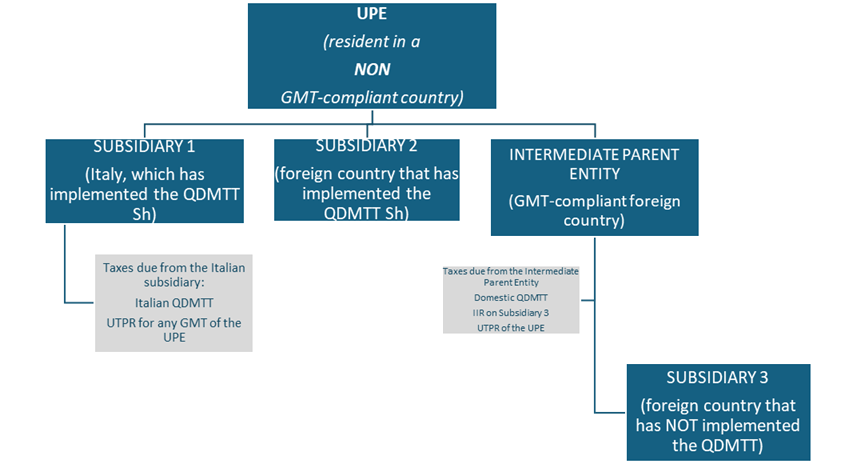
Figure 3 – UPE IN A NON-GMT COUNTRY WITH INTERMEDIATE PARENT ENTITY IN A GMT COUNTRY
In this case, the Intermediate Parent Entity of a company resident in a low-tax country will be required to pay the top-up tax for that country (IIR), thereby effectively relieving Subsidiary 1 and Subsidiary 2 from payment of the supplementary UTPR tax.
As specified, the examples may be endless, especially in situations where the control chain includes sub-groups, intermediate parent entities or sub-holdings partially owned by the UPE, or sub-holdings with different UPEs (so-called jointly controlled entities) resident or not in GMT-compliant countries, parent entities considered to be investment entities, stateless companies, etc.
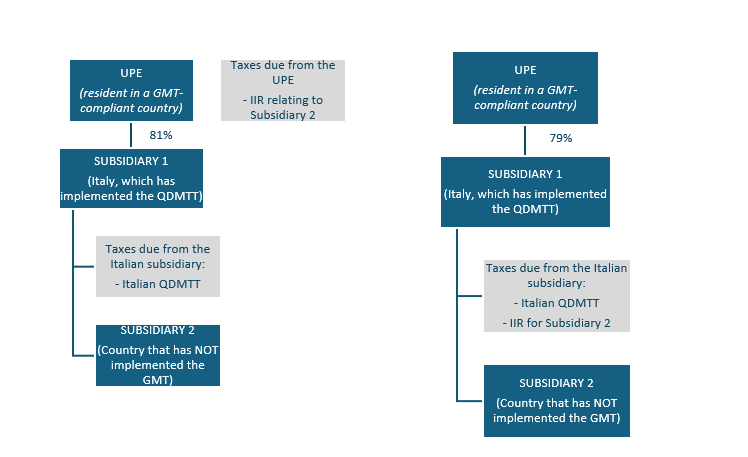
In particular, pursuant to Article 15, paragraph 1, of the LD, a partially owned parent entity located in the territory of the Italian State that at any time during the financial year has directly or indirectly held equity interests in low-tax enterprises located in another country or which are stateless entities, must pay the minimum top-up tax for that year. National provisions set the amount of tax at a level equal to the top-up tax allocated to it in respect of such low-tax enterprises.
The term “partially owned parent entity” means a company (other than the ultimate parent entity, a permanent establishment, an investment entity or an insurance investment entity) whose profit rights are directly or indirectly held for more than 20 per cent by third parties (i.e. one or more natural persons or one or more entities not forming part of the multinational or national group) and which directly or indirectly holds an equity interest in another company of the same multinational or national group (as defined in Annex A).
See the following two examples where a UPE resident in a GMT-compliant country holds, in the first case, an intermediate parent entity for more than 80%, and in the second case for a lower percentage.
3. EXCLUDED ENTITIES
The top-up tax does not apply to
- Any entity qualifying as:
- State entity
- International organization
- Non-profit organization
- Pension fund
- Investment fund that is an ultimate parent entity or a real estate investment vehicle that is an ultimate parent entity. Or,
- Any entity whose value is directly or indirectly held for at least 95 per cent by one or more entities referred to in letter a), taking into account the dilution effect, through one or more excluded entities, with the exception of pension service entities, and which alternatively or jointly:
- Operates exclusively or almost exclusively to hold assets or invest funds for the benefit of one or more entities referred to in letter a).
- Carries out activities that are exclusively ancillary to those performed by one or more entities referred to in letter a).
- Any entity whose value is directly or indirectly held for at least 85 per cent by one or more entities referred to in letter a), taking into account the dilution effect, through one or more excluded entities, with the exception of pension service entities, provided that substantially all its income consists of dividends or capital gains or losses excluded from the calculation of relevant income or loss pursuant to Article 23, paragraph 2, letters b) and c), of the LD.
Of particular importance is the exclusion of UPEs constituted by investment entities. This exclusion arises from the fact that in such entities, generally managed by management companies with third-party funds, as a rule the fund does not assume tax liability, with taxation instead occurring directly at the investor level. For the complexities concerning the application of the GMT in the presence of a UPE that may be classified as an Investment Entity and the consequences, in any event, notwithstanding the UPE being an investment entity, of consolidated group financial statements with turnover not lower than 750 million euros, see the comprehensive note no. 9/2024 in Assonime, “The latent ‘vulnus’ of the Global Minimum Tax with regard to investment entities”.
4. CALCULATION OF THE GMT
As already described, the GMT constitutes a third genus respect to the national income tax IRES and IRAP, the determination of which involves defining the taxable income to which the minimum rate is applied and then deducting the taxes recognized by the local entity and declared in its own tax return.
4.1 Extra Profit – Taxable income (denominator of the ETR ratio)
The methods for determining the income or loss for a company are described in Articles 23-26 of the Legislative decree.
The starting point is the net accounting result (Article 23) (also referred to as FANIL, Financial Accounting Net Income or Loss) calculated in accordance with the accounting standards of the parent company for the consolidated financial statements, before consolidation adjustments.
If it is not possible to determine the net accounting result with precision, the use of other compliant[5] or authorized[6] accounting standards is permitted, provided that the financial statements are actually prepared in accordance with such standards and the reported information is reliable. A critical threshold is set for permanent differences of overall value, which must not exceed one million euros. Above this limit, recourse to the accounting standards of the parent company is mandatory.
The relevant income or loss of a company is equal to the amount of its net accounting profit or loss, adjusted to take account of the following variations (Article 24):
a) Net tax expense
b) Excluded dividends
c) Excluded capital gains or losses on equity interests
d) Taxable net gain or loss from revaluation
e) Capital gains and losses from the transfer of assets and liabilities excluded pursuant to Article 42 of the LD
f) Asymmetric foreign exchange gains or losses
g) Unlawful expenses and non-deductible penalties
h) Errors and changes in accounting principles
i) Accrued pension expenses
Particular attention must be paid to the implications arising from the presence of tax credits, as these may have a significant impact on the calculation of the effective tax rate (“ETR”). In general terms, a tax credit always has an impact on the ETR. However, depending on whether it is treated as relevant income or as a reduction of relevant taxes, the resulting effect will be quite different, considering this second case “worse” for the company.[7]
In order to mitigate the impact on the ETR (because they affect the denominator of the ETR, increasing relevant income, and not the numerator, i.e. Covered Taxes), they must fall within the following two categories:
– Qualified refundable tax credits (as set out in the Model Rules). The legislature defines a qualified refundable tax credit as a refundable credit designed in such a way that it must be paid in cash or equivalent to the company within four years from the date on which the company becomes entitled to receive the refundable tax credit (a tax credit offset through horizontal compensation is also regarded as refundable).
– Marketable transferable tax credits (as set out in the Model Rules). A marketable transferable tax credit is a transferable tax credit that may be used by the holder to offset the relevant taxes of the country that granted such credit.
From the above it follows that, for the purposes of calculating the ETR, the granting of grants and incentives in the form of tax credits is more favourable than permanent deductions of income or reductions in the tax rate.
By way of example, the “old” ordinary ACE operated as a permanent reduction of the taxable income. Accordingly, such tax incentive could not in any way be defined as a qualified or transferable credit and its impact on the ETR would therefore not have been mitigated in any manner.
Similarly, the new Patent Box pursuant to Article 6 of Decree-Law no. 146/2021, being structured as a “super deduction” of research and development costs, results in a permanent variation of the taxable income, negatively reducing the amount of Covered Taxes in the numerator of the ETR for the taxpayer.
The law (Article 25 of the LD) also establishes the calculation of the net accounting profit or loss for entities classified as permanent establishments. This calculation must comply with specific accounting principles and may be adjusted so as to include only the income components attributable to the permanent establishment, including solely the positive income components which, and to the extent that, are exempt in the country of location of the head office and which are attributable to activities carried out outside that country, as well as the negative income components which, and to the extent that, are not deducted in the country of location of the head office and which are attributable to the aforementioned activities.
Furthermore, the relevant loss of a permanent establishment is deductible exclusively from the income of the head office if it is recognised by the country of location of the head office as a deductible expense and such loss is not offset by positive income components that are taxable under the laws of that country and of the country of location of the permanent establishment.
For the purposes of determining the top-up tax, the relevant net income, as determined above, is reduced by income deriving from the performance of substantial economic activity, the so-called SBIE (Ministerial Decree 11 October 2024). The figures to be taken into account are those relevant for the preparation of the consolidated financial statements of the parent company.
The deduction for payroll costs is equal to 5% of their amount (even if capitalised and including share-based payments). However, in the transitional period the 5% rate is replaced by those indicated in Annex B to the LD:
a) 10 per cent in 2023
b) 9.8 per cent in 2024
c) 9.6 per cent in 2025
d) 9.4 per cent in 2026
e) 9.2 per cent in 2027
f) 9.0 per cent in 2028
g) 8.2 per cent in 2029
h) 7.4 per cent in 2030
i) 6.6 per cent in 2031
l) 5.8 per cent in 2032
The deduction for tangible fixed assets is equal to 5 per cent of the net book value of eligible tangible fixed assets, corresponding to the average of their net book value at the beginning and at the end of the financial year. As an exception to the previous paragraph, the 5 per cent rate is replaced by the rate indicated in Annex B to the LD as follows:
a) 8 per cent in 2023
b) 7.8 per cent in 2024
c) 7.6 per cent in 2025
d) 7.4 per cent in 2026
e) 7.2 per cent in 2027
f) 7.0 per cent in 2028
g) 6.6 per cent in 2029
h) 6.2 per cent in 2030
i) 5.8 per cent in 2031
l) 5.4 per cent in 2032
4.2 Adjusted covered taxes (numerator of the ETR ratio)
The taxes to be considered (those “relevant” for the purposes of Article 27 of the LD), the Covered Taxes, are those indicated in the annual accounts of each company when preparing the consolidated group financial statements. For the purposes at hand, the following are relevant:
i) Income taxes of the company.
ii) Income taxes incurred by entity in which the company participates and allocated to it on a transparent basis;
iii) Taxes paid by the company on distributed dividends;
iv) Taxes paid by the company on dividends presumed to be distributed or on non-deductible expenses considered as hidden forms of distribution;
v) Taxes paid on a lump-sum basis, and in any event in substitution for ordinary income taxes;
vi) Taxes paid on undistributed profit reserves;
vii) Taxes paid on alternative forms of taxation of capital or of mixed income and capital components.
Each of the above items would warrant further analysis. However, given the purpose of the document to provide a general overview of the rules, it is sufficient to note that for Italian purposes the above-mentioned Covered Taxes certainly include IRES and, albeit with greater reservations, IRAP.
With regard to point iii), it would appear (Article 31, paragraph 5, of the LD) that the levy made in the form of withholding tax on the amount of profit placed in distribution is relevant as Covered Tax attributable to the distributing company even if the related benefit (tax credit) is recognised by the recipient for accounting purposes. This rule applies both where the distributed profit is not classified as a dividend in the jurisdiction of the recipient and in cases of presumed dividend distributions. The tax in question is relevant in the tax period in which it is paid. It follows that there is no difference between the distribution of profit for the current financial year and that of profits accumulated in previous financial years.
Once the relevant Covered Taxes have been identified, their values must be possibly adjusted through the adjustment procedure envisaged in Article 4 of the GloBE Rules as transposed into Article 28 of the Decree (Adjusted Covered Taxes).
ADJUSTED COVERED TAXES
The following give rise to an upward adjustment of Covered Taxes:
- Taxes that have not been recognized in the accounts for the financial year although due.
- Taxes arising from the use of losses carried forward (which are also subject to a specific alternative regime).
- Taxes that had been set aside in risk provisions (and therefore had not been treated as Covered Taxes due to their uncertainty) in previous financial years and that become definite in the current year.
- Particular consideration must be given to tax credits that, as already specified above, are divided into two main categories: Qualified Refundable Tax Credits (QRTC) and Non-Qualified Refundable Tax Credits (NQRTC). QRTCs are tax credits that can be offset against any tax or contribution due and that are refundable within four years. If they recognised in the financial statements as a reduction of taxes due, they give rise to a double adjustment: they are removed from the computation of taxes for the year (increasing their amount) and added to positive income components (increasing GloBE Income). NQRTCs, on the other hand, are tax credits that can be offset only against specific taxes or contributions and are refundable over a period exceeding four years. If presented in the financial statements as a reduction of the tax for the period, they do not give rise to any adjustment. In conclusion, while QRTCs are recognised as a separate item as a positive income component, NQRTCs are not recognised either among positive income components or among taxes for the year.
Example of the impact of QRTCs on Adjusted Covered Taxes depending on whether the QRTC component is included in Profit Before Tax (in general in Italian financial statements) or deducted from taxes:
| Profit Before Tax (PBT) | 1,000 | Profit Before Tax (PBT) inclusive of QRTC x 100 | 1,100 |
| Taxes for the year | 100 | Taxes for the year | 200 |
| Of which QRTC | (100) | Of which QRTC | – |
| GloBE Income (PBT+QRTC) | 1,100 | GloBE Income (PBT+QRTC) | 1,100 |
| Adjusted Covered Taxes | 200 | Adjusted Covered Taxes | 200 |
| ETR | 18.18% | ETR | 18.18% |
In the second case there are no adjustments.
Example of the impact of QRTCs on Adjusted Covered Taxes depending on whether the NQRTC component is included in Profit Before Tax (in general in Italian financial statements) or deducted from taxes:
| Profit Before Tax (PBT) | 1,000 | Profit Before Tax (PBT) inclusive of NQRTC x 100 | 1,100 |
| Taxes for the year | 100 | Taxes for the year | 200 |
| Of which NQRTC | (100) | Of which QRTC | – |
| GloBE Income (PBT) | 1,000 | GloBE Income (PBT-NQRTC) | 1,000 |
| Adjusted Covered Taxes | 100 | Adjusted Covered Taxes (Taxes-NQRTC) | 100 |
| ETR | 10% | ETR | 10% |
In contrast, the following give rise to a downward adjustment:
- Taxes recognised in the financial statements that relate to items not included in GloBE Income, i.e. a tax recognised as such in the financial statements is treated as a Covered Tax only insofar as it corresponds to an item that is recognised as part of GloBE Income. By way of example, consider taxes on the taxable portion of dividends or PEX capital gains (5%), it being noted that the definition of dividends and capital gains excluded for GloBE purposes differs from that for IRES purposes, with the result that there may be capital gains and dividends excluded for IRES but not for GloBE, and vice versa.
- Any amount attributable to Non-Qualified Refundable Tax Credits (NQRTC) that has not been disclosed in the financial statements as a reduction of taxes for the year.
- Any amount refunded or recognised as a tax credit that does not qualify as a Qualified Refundable Tax Credit (QRTC).
- Tax provisions – where recognised as such in the financial statements – where their recognition is intended to cover liabilities deemed probable even though the related expense has not yet fully crystallised.
- The portion of current taxes that is payable in a period exceeding the subsequent three years.
Amounts recognised for deferred taxation also fall within Covered Taxes (Article 28, paragraph 1, of the LD). The determination of deferred taxation is highly varied and ranges from the computation of depreciation and amortisation – potentially different for accounting and tax purposes – to the early taxation of certain items (maintenance exceeding certain thresholds) or the deferral of others (deferred taxation of capital gains). Deferred taxation also includes the attribution of a value (not necessarily nominal) to tax losses carried forward.
The GloBE Rules sought to identify a reasonable balance point by defining a value known as the Total Deferred Tax Adjustment Amount (TDTAA), which encompasses a plurality of items with the purpose of consolidating transactions of even opposing effect.
The TDTAA gives relevance to deferred taxation where it is recognised in the financial statements. However, deferred taxes are relevant for GloBE Rules purposes only up to an amount that cannot exceed the Minimum Tax, i.e. by applying a rate of 15% to the associated taxable income. This approach has an anti-avoidance purpose, aimed at preventing circumvention or dilatory effects that may arise from policies creating an excessive divergence between the recognition of deferred taxes and their actual settlement.
Adjustments arising from deferred taxation are frequent and significant, and the first point to consider is the five-year limit. This operates as a sort of period within which all deferral effects should be resolved. The second point concerns the treatment of the difference between the amount recognised in the financial statements and the amount admissible as an adjustment of the Covered Taxes, which cannot exceed the value of the Minimum Tax.
Deferred taxation must be removed (pursuant to Article 29 of the LD):
a) Of the portion of Deferred Taxes relating to items that do not contribute to the formation of GloBE Income (which in practice constitutes permanent differences for GloBE purposes).
b) Of the portion of Deferred Taxes relating to provisions for risks but not for actual tax liabilities (so-called Disallowed Accruals).
c) Of the portion of Deferred Taxes relating to items that are not expected to be paid in the subsequent five tax periods (so-called Unclaimed Accruals).
d) Of any Deferred Taxes deriving from valuation adjustments or accounting restatements.
e) Of the portion of Deferred Taxes relating to the redetermination of the nominal tax rate.
f) Of the portion of Deferred Taxes relating to the recognition of tax credits.
For the purposes of determining deferred tax assets, tax losses are also relevant even if not recognised in the financial statements (Article 29, paragraph 4, of the LD).
Pursuant to the Ministerial Decree of 27 December 2024, deferred tax assets and liabilities existing at the beginning of the first financial year of application of GloBE are relevant for the calculation of the effective tax rate for that year and subsequent years, even where they consist of deferred tax assets not recognised in the financial statements due to the absence of the relevant accounting requirements. Such assets and liabilities must be recalculated by applying the minimum tax rate for GloBE purposes (15%).
Taxes other than those listed herein are not relevant for the purposes of inclusion among the Covered Taxes, which therefore constitute an exhaustive list. In particular, as specified in Article 4.2.2 of the GloBE Rules, the following do not qualify: (a) Top-Up Taxes (i.e. “supplementary” taxes other than national taxes) wherever paid, (b) “supplementary” taxes arising from the application of the UTPR mechanisms, (c) taxes deriving from the application of an unrecognised tax imputation system (other than those contemplated above), (d) taxes paid by insurance companies on behalf of their customers.
5. SAFE HARBOUR
The difficulties in implementing Pillar Two and the complex calculations required to determine the Top-Up Tax (TUT) prompted the OECD to introduce so-called Safe Harbours (SH) in order to simplify the process, divided into temporary and permanent mechanisms.
5.1 Transitional Safe Harbours
The Transitional Safe Harbour is a temporary provision introduced by the OECD to simplify the implementation of Pillar Two of the Global Minimum Tax (GMT). This mechanism is divided into two main categories: the CbCR Safe Harbour and the UTPR Safe Harbour, the main version of which is described below.
CbCR Safe Harbour: This mechanism allows multinational groups to use simplified accounting information contained in the Country-by-Country Report (CbCR). The CbCR SH applies to fiscal years beginning on or before 31 December 2026 and ending no later than 30 June 2028. By using the CbCR, groups can limit the burden of performing the complex calculations required by the GloBE Rules to a reduced number of higher-risk jurisdictions, thereby reducing compliance costs and burdens. To be used for SH purposes, the CbCR must be “qualified”, i.e. prepared on the basis of financial statements drawn up in accordance with the accounting standards used by the Ultimate Parent Company (UPE). The values to be taken as a reference for assessing the applicability of the CbCR SH differ from those defined by the GloBE Rules for the determination of GloBE Income and (Adjusted) Covered Taxes. The CbCR SH provides that no top-up tax is due by the group in a given jurisdiction if at least one of the following tests is satisfied: de minimis test, Simplified ETR test and Routine-Profit test.
De minimis test:
- This test provides that no top-up tax is due by the group in each jurisdiction if aggregated revenues are below 10 million euros and aggregated profit before tax (PBT) is below 1 million euros, or if a loss has been recorded. The thresholds indicated correspond to those envisaged in Article 37 of Legislative Decree no. 209/2023 in order to benefit from the de minimis exclusion.
- Consider a multinational group operating in a jurisdiction with aggregated revenues of 8 million euros and aggregated profit before tax (PBT) of 500,000 euros. Since revenues are below 10 million euros and PBT is below 1 million euros, the group passes the de minimis test and is not required to pay any top-up tax.
Simplified ETR test:
- The Simplified ETR is determined as the ratio between Simplified Covered Taxes and the PBT resulting from the CbCR. If the Simplified ETR is equal to or higher than the Transition Rate, which is 15% for fiscal years beginning in 2023 or 2024, 16% for those beginning in 2025, and 17% for those beginning in 2026, no top-up tax is due. If the Simplified ETR is lower than the Transition Rate, the group must proceed with the determination of the ETR in accordance with the GloBE Rules.
- Example of application of the Simplified ETR test: Consider a multinational group with a PBT resulting from the CbCR of 10 million euros and Simplified Covered Taxes of 1.6 million euros. The Simplified ETR is calculated as the ratio between Covered Taxes and PBT, i.e. 1.6 million euros divided by 10 million euros, resulting in an ETR of 16%. If the fiscal year begins in 2025, the Transition Rate is 16%, therefore the group passes the Simplified ETR test and is not required to pay any top-up tax.
Routine-Profit test:
This test provides that no top-up tax is due if the amount of the Substance-based Income Exclusion (SBIE) calculated in accordance with the GloBE Rules is equal to or higher than the PBT resulting from the CbCR. In calculating the SBIE, wages and tangible assets relating to entities that are not qualified as Constituent Entities (CE) for CbCR purposes are not taken into account. The test is automatically passed if the PBT is equal to zero or negative.
Example of application of the Routine-Profit test:: Assume that a multinational group has a PBT resulting from the CbCR of 2 million euros and a Substance-based Income Exclusion (SBIE) calculated in accordance with the GloBE Rules of 2.5 million euros. Since the SBIE amount is equal to or greater than the PBT, the group passes the Routine-Profit test and is not required to pay any top-up tax.
5.2 Permanent Safe Harbour
The Permanent Safe Harbour is a permanent simplification measure introduced by the OECD to reduce compliance burdens on a long-term basis for multinational groups operating in jurisdictions with a QDMTT. Unlike the Transitional Safe Harbours, this mechanism is not limited to the first years of application of the Pillar Two legislation, but is permanent.
Requirements for the QDMTT Permanent Safe Harbour:
In order for a QDMTT to be considered valid for SH purposes, it must cumulatively meet three requirements:
- QDMTT Accounting Standard: The QDMTT must be calculated using the accounting standards of the UPE or local accounting standards that meet specific requirements. Such standards may be based on the accounting standards of the UPE or on local accounting standards that meet specific requirements.
Accounting standards of the UPE:
- The QDMTT may be calculated using the accounting standards applied by the UPE in preparing the consolidated financial statements.
Local accounting standards:
- The QDMTT may be calculated using local accounting standards, provided that all Constituent Entities (CE) in the jurisdiction prepare financial statements or reports in compliance with domestic tax or corporate laws or financial statements or reports subject to external audit.
- Local accounting standards must be permitted or required by an Authorised Accounting Body or must be considered acceptable or authorised under domestic legislation.
Where more than one set of accounting standards complying with the Local Financial Accounting Standard rule exists within the same jurisdiction, a tie-break rule must be provided in order to avoid tax planning risks.
- Consistency Standard: The calculations for determining the QDMTT must be consistent with those required by the GloBE Rules.
The Consistency Standard requires that the calculations for determining the Qualified Domestic Minimum Top-Up Tax (QDMTT) comply with those required by the GloBE Rules for the purposes of determining the Income Inclusion Rule (IIR) and the Undertaxed Profit Rule (UTPR). However, there are certain mandatory and optional variations that must be taken into account.
Mandatory variations:
- The first variation provides that the QDMTT must not take account of cross-border taxes.
- The second variation requires that the QDMTT be calculated in the local currency where it is based on financial statements prepared under local accounting standards and provided that all Constituent Entities (CE) in the jurisdiction prepare their financial statements in accordance with the same accounting standards.
Optional variations:
Optional variations must be assessed on a case-by-case basis and are relevant insofar as they result in a charge equivalent to or greater than the TUT. The Consistency Standard is considered to be met where the calculation envisaged by domestic regulations excludes or limits the Substance-based Income Exclusion (SBIE), the de minimis exclusion, and where the Minimum Tax Rate is higher than 15%.
- Administration Standard: QDMTT jurisdictions must be subject to an ongoing monitoring process to ensure that the obligations to collect and report the relevant information are fulfilled in a manner consistent with the GloBE Rules.
The Administration Standards are requirements that QDMTT jurisdictions must meet to ensure that the obligations to collect and report the relevant information are fulfilled in a manner consistent with the GloBE Rules. These standards are essential to ensure that jurisdictions maintain an ongoing monitoring process and that the necessary information is collected and reported correctly.
Ongoing monitoring process:
- QDMTT jurisdictions must be subject to an ongoing monitoring process. This process is essential to ensure that the obligations to collect and report the relevant information are fulfilled in a manner consistent with the GloBE Rules.
Verification of information:
- Verification is carried out on the basis of the information and data reported in the GloBE Information Return (GIR). This document contains all the information necessary to assess whether a jurisdiction complies with the Administration Standards.
Peer Review:
The OECD/G20 IF will rely on a peer review process to assess whether a QDMTT effectively complies with the Administration Standards. Verification will concern the manner in which the jurisdiction regulates and applies the domestic minimum tax, without regard to the specific circumstances of the individual groups subject to it.
Critical observations:
Despite the intended simplification, the QDMTT SH may not in fact alleviate the administrative costs of the GMT. The need to reflect a full transposition of the GloBE Rules and the very Standards that must be integrated in order to establish whether the QDMTT is genuinely consistent with the GloBE Rules appears to reveal a requirement for oversight and centralisation by the OECD.
5.3 Countries that have adopted the QDMTT and the QDMTT SH
The list of jurisdictions that have implemented the Income Inclusion Rule (IIR) and the domestic minimum tax (DMTT) and that have obtained transitional “qualified” status for their legislation following the review process carried out by the Inclusive Framework on BEPS is updated on the OECD institutional website (https://www.oecd.org/content/dam/oecd/en/topics/policy-sub-issues/global-minimum-tax/administrative-guidance-globe-rules-pillar-two-central-record-legislation-transitional-qualified-status.pdf).
The list also reports the date from which the listed legislation is to be considered “qualified”.
Qualified Income Inclusion Rules
| Domestic law | Effective date | |
| Australia | Taxation (Multinational – Global and Domestic Minimum Tax) Imposition Bill 2024 Taxation (Multinational – Global and Domestic Minimum Tax) Bill 2024 | 1 January 20241 |
| Austria | Bundesgesetz zur Gewährleistung einer globalen Mindestbesteuerung für Unternehmensgruppen (Mindestbesteuerungsgesetz – MinBestG) | 31 December 2023 |
| Belgium | Loi portant l’introduction d’un impôt minimum pour les groupes d’entreprises multinationales et les groupes nationaux de grande envergure Wet houdende de invoering van een minimumbelasting voor multinationale ondernemingen en omvangrijke binnenlandse groepen | 31 December 2023 |
| Bulgaria | ЗАКОН за корпоративното подоходно облагане | 31 December 2023 |
| Canada | Global Minimum Tax Act Loi sur l’impôt minimum mondial | 31 December 2023 |
| Croatia | Zakon o minimalnom globalnom porezu na dobit | 31 December 2023 |
| Czechia | Zákon č. 416/2023 Sb., o dorovnávacích daních pro velké nadnárodní skupiny a velké vnitrostátní skupiny | 31 December 2023 |
| Denmark | Lov nr. 1535 af 12. december 2023 om en ekstraskat for visse koncernenheder (minimumsbeskatningsloven) | 31 December 2023 |
| Finland | Laki suurten konsernien vähimmäisverosta 1308/2023 | 31 December 2023 |
| France | Imposition minimale mondiale des groupes d’entreprises multinationales et des groupes nationaux (Code général des impôts, Chapitre II bis, article 223 VJ à 223 WZ) | 31 December 2023 |
| Germany | Gesetz zur Gewährleistung einer globalen Mindestbesteuerung für Unternehmensgruppen (Mindeststeuergesetz – MinStG) | 31 December 2023 |
| Gibraltar | Global Minimum Tax Act 2024 (2024-20) | 1 January 2025 |
| Greece | NOMOΣ ΥΠ’ ΑΡΙΘΜ. 5100 Ενσωμάτωση της Οδηγίας (ΕΕ) 2022/2523 του Συμβουλίου, της 14ης Δεκεμβρίου 2022, σχετι-κά με την εξασφάλιση παγκόσμιου ελάχιστου επιπέδου φορολογίας των ομίλων πολυεθνικών επιχειρήσεων και των εγχώριων ομίλων μεγάλης κλίμακας στην Ευρωπαϊκή Ένωση (Pillar II) και άλ-λες επείγουσες διατάξεις | 31 December 2023 |
| Guernsey | Income Tax (Approved International Agreements) (Implementation) (OECD Pillar Two GloBE Model Rules) Regulations, 2024 | 1 January 2025 |
1 Self-certification based on draft legislation.
| Domestic law | Effective date | |
| Hungary | 2023. évi LXXXIV. Törvény a globális minimum-adószintet biztosító kiegészítő adókról és ezzel összefüggésben egyes adótörvények módosításáról | 31 December 2023 |
| Indonesia | Pengenaan Pajak Minimum Global Berdasarkan Kesepakatan Internasional (PMK 136 TAHUN 2024) | 1 January 2025 |
| Ireland | Taxes Consolidation Act 1997, Part 4A (Implementation Of Council Directive (EU) 2022/2523 of 15 December 2022 on Ensuring a Global Minimum Level of Taxation For Multinational Enterprise Groups and Large Scale Domestic Groups in the Union) | 31 December 2023 |
| Isle of Man | Global Minimum Tax (Pillar Two) Order 2024, Statutory Document No. 2024/0234 | 1 January 2025 |
| Italy | DECRETO LEGISLATIVO 27 dicembre 2023, n. 209 Attuazione della riforma fiscale in materia di fiscalita’ internazionale | 31 December 2023 |
| Japan | 各対象会計年度の国際最低課税額に対する法人税(法人税法第二編第二章) 特定基準法人税額に対する地方法人税(地方法人税法第三章) | 1 April 2024 |
| Jersey | Multinational Taxation (Global Anti-Base Erosion – IIR Tax) (Jersey) Law 2025 | 1 January 2025 |
| Korea | 국제조세조정에 관한 법률 제3절 추가세액의 과세 (제72조(소득산입규칙의 적용)) | 1 January 2024 |
| Liechtenstein | Gesetz vom 10. November 2023 über die Mindestbesteuerung grosser Unternehmensgruppen (GloBE-Gesetz) | 1 January 2024 |
| Luxembourg | Loi du 22 décembre 2023 relative à l’imposition minimale effective en vue de la transposition de la directive (UE) 2022/2523 du Conseil du 15 décembre 2022 visant à assurer un niveau minimum d’imposition mondial pour les groupes d’entreprises multinationales et les groupes nationaux de grande envergure dans l’Union | 31 December 2023 |
| Malaysia | Act 851 – Finance (No. 2) Act 2023, Section 30 | 1 January 2025 |
| Netherlands | Wet minimumbelasting 2024 | 31 December 2023 |
| New Zealand | Taxation (Annual Rates for 2023–24, Multinational Tax, and Remedial Matters) Act 2024 | 1 January 2025 |
| North Macedonia | Закон за минимален глобален данок на добивка („Службен весник на Република Северна Македонија“ бр.3/25) | 1 January 2024 |
| Norway | Lov 12. januar 2024 nr 1 om suppleringsskatt på underbeskattet inntekt i konsern (suppleringsskatteloven) | 1 January 2024 |
| Poland | Ustawa z dnia 6 listopada 2024 r. o opodatkowaniu wyrównawczym jednostek składowych grup międzynarodowych i krajowych (Dz.U. 2024 poz.1685) | 1 January 20242 |
| Portugal | Lei n.º 41/2024, de 8 de novembro | 1 January 2024 |
| Romania | Lege nr. 431/2023 privind asigurarea unui nivel minim global de impozitare a grupurilor de întreprinderi multinaționale și a grupurilor naționale de mari dimensiuni | 31 December 2023 |
| Domestic law | Effective date | |
| Singapore | Multinational Enterprise (Minimum Tax) Act 2024 | 1 January 2025 |
| Slovenia | Zakon o minimalnem davku (ZMD); Uradni list RS, št. 131/2023) | 31 December 2023 |
| South Africa | Global Minimum Tax Act (Act No. 46 of 2024) | 1 January 2024 |
| Spain | Ley 7/2024, de 20 de diciembre, por la que se establecen un impuesto complementario para garantizar un nivel mínimo global de imposición para los grupos multinacionales y los grupos nacionales de gran magnitud, un impuesto sobre el margen de intereses y comisiones de determinadas entidades financieras y un impuesto sobre los líquidos para cigarillos electrónicos y otros productos relacionados con el tabaco, y se modifican otras normas tributarias | 31 December 2023 |
| Sweden | Lag (2023:875) om tilläggsskatt | 31 December 2023 |
| Switzerland | Ordonnance sur l’imposition minimale des grands groupes d’entreprises du 22 décembre 2023 (État le 1er janvier 2025), RS 642.161 Verordnung über die Mindestbesteuerung grosser Unternehmensgruppen vom 22. Dezember 2023 (Stand am 1. Januar 2025), RS 642.161 Ordinanza concernente l’imposizione minima dei grandi gruppi di imprese del 22 dicembre 2023 (Stato 1° gennaio 2025), RS 642.161 | 1 January 2025 |
| Thailand | พระราชกําหนดภาษีส่วนเพิ่ม พ.ศ.2567 | 1 January 2025 |
| Türkiye | Kanun Numarası 5520 KURUMLAR VERGİSİ KANUNU (BEŞİNCİ KISIM Yerel ve Küresel Asgari Tamamlayıcı Kurumlar Vergisi ve Geçici Maddeler) | 1 January 2024 |
| United Kingdom | Finance (No. 2) Act 2023, Part 3 (Multinational Top-up Tax) & Schedules 14 15, 16, 16A and 17 | 31 December 2023 |
| Viet Nam | Nghị quyết số 107/2023/QH15 của Quốc hội: Về việc áp dụng thuế thu nhập doanh nghiệp bổ sung theo quy định chống xói mòn cơ sở thuế toàn cầu | 1 January 2024 |
Qualified Domestic Minimum Top-up Tax Rules and QDMTT Safe Harbours
| Domestic law | QDMTT Safe Harbour | Effective date | |
| Australia | Taxation (Multinational – Global and Domestic Minimum Tax) Imposition Bill 2024 Taxation (Multinational – Global and Domestic Minimum Tax) Bill 2024 | Yes | 1 January 20243 |
| Austria | Bundesgesetz zur Gewährleistung einer globalen Mindestbesteuerung für Unternehmensgruppen (Mindestbesteuerungsgesetz – MinBestG) | Yes | 31 December 2023 |
| Barbados | Corporation Top-up Tax Act, 2024-16 | Yes | 1 January 20244 |
| Belgium | Loi portant l’introduction d’un impôt minimum pour les groupes d’entreprises multinationales et les groupes nationaux de grande envergure Wet houdende de invoering van een minimumbelasting voor multinationale ondernemingen en omvangrijke binnenlandse groepen | Yes | 31 December 2023 |
| Brazil | Lei Nº 15.079, de 27 de dezembro de 2024 | Yes | 1 January 2025 |
| Bulgaria | ЗАКОН за корпоративното подоходно облагане | Yes | 31 December 2023 |
| Canada | Global Minimum Tax Act Loi sur l’impôt minimum mondial | Yes | 31 December 2023 |
| Croatia | Zakon o minimalnom globalnom porezu na dobit | Yes | 31 December 2023 |
| Czechia | Zákon č. 416/2023 Sb., o dorovnávacích daních pro velké nadnárodní skupiny a velké vnitrostátní skupiny | Yes | 31 December 2023 |
3 Self-certification based on draft legislation.
| Domestic law | QDMTT Safe Harbour | Effective date | |
| Denmark | Lov nr. 1535 af 12. december 2023 om en ekstraskat for visse koncernenheder (minimumsbeskatningsloven) | Yes | 31 December 2023 |
| Finland | Laki suurten konsernien vähimmäisverosta 1308/2023 | Yes | 31 December 2023 |
| France | Imposition minimale mondiale des groupes d’entreprises multinationales et des groupes nationaux (Code général des impôts, Chapitre II bis, article 223 VJ à 223 WZ) | Yes | 31 December 2023 |
| Germany | Gesetz zur Gewährleistung einer globalen Mindestbesteuerung für Unternehmensgruppen (Mindeststeuergesetz – MinStG) | Yes | 31 December 2023 |
| Gibraltar | Global Minimum Tax Act 2024 (2024-20) | Yes | 1 January 2024 |
| Greece | NOMOΣ ΥΠ’ ΑΡΙΘΜ. 5100 Ενσωμάτωση της Οδηγίας (ΕΕ) 2022/2523 του Συμβουλίου, της 14ης Δεκεμβρίου 2022, σχετι-κά με την εξασφάλιση παγκόσμιου ελάχιστου επιπέδου φορολογίας των ομίλων πολυεθνικών επιχειρήσεων και των εγχώριων ομίλων μεγάλης κλίμακας στην Ευρωπαϊκή Ένωση (Pillar II) και άλ-λες επείγουσες διατάξεις | Yes | 31 December 2023 |
| Guernsey | Income Tax (Approved International Agreements) (Implementation) (OECD Pillar Two GloBE Model Rules) Regulations, 2024 | Yes | 1 January 2025 |
| Hungary | 2023. évi LXXXIV. Törvény a globális minimum-adószintet biztosító kiegészítő adókról és ezzel összefüggésben egyes adótörvények módosításáról | Yes | 31 December 2023 |
| Indonesia | Pengenaan Pajak Minimum Global Berdasarkan Kesepakatan Internasional (PMK 136 TAHUN 2024) | Yes | 1 January 2025 |
| Ireland | Taxes Consolidation Act 1997, Part 4A (Implementation Of Council Directive (EU) 2022/2523 of 15 December 2022 on Ensuring a Global Minimum Level of Taxation For Multinational Enterprise Groups and Large Scale Domestic Groups in the Union) | Yes | 31 December 2023 |
| Isle of Man | Global Minimum Tax (Pillar Two) Order 2024, Statutory Document No. 2024/0234 | Yes | 1 January 2025 |
| Italy | DECRETO LEGISLATIVO 27 dicembre 2023, n. 209 Attuazione della riforma fiscale in materia di fiscalita’ internazionale | Yes | 31 December 2023 |
| Japan | 各対象会計年度の国内最低課税額に対する法人税(法人税法第二編第二章第一節・第四節、第三編第三章第二節 ) 国内最低課税額に係る特定基準法人税額に対する地方法人税(地方法人税法第四章) | Yes | 1 April 2026 |
| Liechtenstein | Gesetz vom 10. November 2023 über die Mindestbesteuerung grosser Unternehmensgruppen (GloBE-Gesetz) | Yes | 1 January 2024 |
| Luxembourg | Loi du 22 décembre 2023 relative à l’imposition minimale effective en vue de la transposition de la directive (UE) 2022/2523 du Conseil du 15 décembre 2022 visant à assurer un niveau minimum d’imposition mondial pour les groupes d’entreprises multinationales et les groupes nationaux de grande envergure dans l’Union | Yes | 31 December 2023 |
| Malaysia | Act 851 – Finance (No. 2) Act 2023, Section 30 | Yes | 1 January 2025 |
| Netherlands | Wet minimumbelasting 2024 | Yes | 31 December 2023 |
| North Macedonia | Закон за минимален глобален данок на добивка („Службен весник на Република Северна Македонија“ бр.3/25) | Yes | 1 January 2024 |
| Norway | Lov 12. januar 2024 nr 1 om suppleringsskatt på underbeskattet inntekt i konsern (suppleringsskatteloven) | Yes | 1 January 2024 |
| Poland | Ustawa z dnia 6 listopada 2024 r. o opodatkowaniu wyrównawczym jednostek składowych grup międzynarodowych i krajowych (Dz.U. 2024 poz.1685) | Yes | 1 January 20245 |
| Portugal | Lei n.º 41/2024, de 8 de novembro | Yes | 1 January 2024 |
| Romania | Lege nr. 431/2023 privind asigurarea unui nivel minim global de impozitare a grupurilor de întreprinderi multinaționale și a grupurilor naționale de mari dimensiuni | Yes | 31 December 2023 |
| Singapore | Multinational Enterprise (Minimum Tax) Act 2024 | Yes | 1 January 2025 |
| Slovak Republic | Zákon č. 507/2023 Z. z. o dorovnávacej dani na zabezpečenie minimálnej úrovne zdanenia nadnárodných skupín podnikov a veľkých vnútroštátnych skupín a o doplnení zákona č. 563/2009 Z. z. o správe daní (daňový poriadok) a o zmene a doplnení niektorých zákonov v znení neskorších predpisov | Yes | 31 December 2023 |
| Slovenia | Zakon o minimalnem davku (ZMD); Uradni list RS, št. 131/2023) | Yes | 31 December 2023 |
| South Africa | Global Minimum Tax Act (Act No. 46 of 2024) | Yes | 1 January 2024 |
| Spain | Ley 7/2024, de 20 de diciembre, por la que se establecen un impuesto complementario para garantizar un nivel mínimo global de imposición para los grupos multinacionales y los grupos nacionales de gran magnitud, un impuesto sobre el margen de intereses y comisiones de determinadas entidades financieras y un impuesto sobre los líquidos para cigarillos electrónicos y otros productos relacionados con el tabaco, y se modifican otras normas tributarias | Yes | 31 December 2023 |
| Sweden | Lag (2023:875) om tilläggsskatt | Yes | 31 December 2023 |
| Switzerland | Ordonnance sur l’imposition minimale des grands groupes d’entreprises du 22 décembre 2023 (État le 1er janvier 2025), RS 642.161 Verordnung über die Mindestbesteuerung grosser Unternehmensgruppen vom 22. Dezember 2023 (Stand am 1. Januar 2025), RS 642.161 | Yes | 1 January 2024 |
| Domestic law | QDMTT Safe Harbour | Effective date | |
| Ordinance concerning the minimum taxation of large groups of entities of 22 December 2023 (status as at 1 January 2025), RS 642.161 | |||
| Thailand | พระราชกําหนดภาษีส่วนเพิ่ม พ.ศ.2567 | Yes | 1 January 2025 |
| Türkiye | Kanun Numarası 5520 KURUMLAR VERGİSİ KANUNU (BEŞİNCİ KISIM Yerel ve Küresel Asgari Tamamlayıcı Kurumlar Vergisi ve Geçici Maddeler) | Yes | 1 January 2024 |
| United Arab Emirates | Cabinet Decision No. 142 of 2024 on the Imposition of Top-up Tax on Multinational Enterprises | Yes | 1 January 2025 |
| United Kingdom | Finance (No. 2) Act 2023, Part 4 (Domestic Top-up Tax) & Schedules 14, 15, 16, 16A, 17, and 18 | Yes | 31 December 2023 |
| Viet Nam | Nghị quyết số 107/2023/QH15 của Quốc hội: Về việc áp dụng thuế thu nhập doanh nghiệp bổ sung theo quy định chống xói mòn cơ sở thuế toàn cầu | Yes | 1 January 2024 |
6. REPORTING, PAYMENT AND ASSESSMENT OBLIGATIONS
6.1 Notification of Designation to submit the Relevant Communication
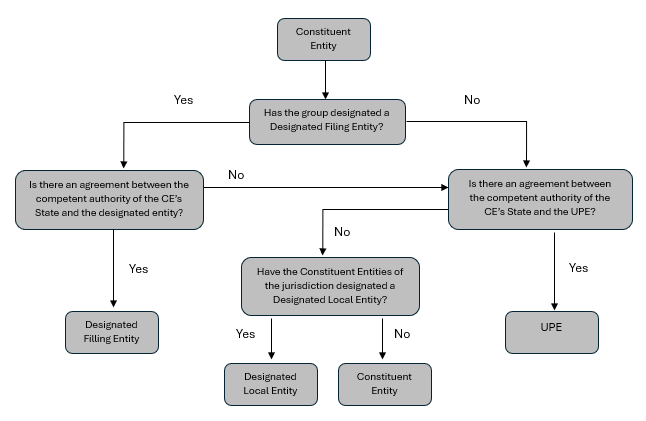
The initial communication is the so-called Notification of Designation (Ministerial Decree of 25 February 2025 issued pursuant to Article 51, paragraph 4, of the LD), by means of which local entities and stateless entities incorporated under Italian law, falling within the scope of application of the Global Minimum Tax, inform the tax authorities of their intention to delegate another group entity to submit the “relevant communication” (GIR) on their behalf. The designated group entity may be:
- A designated local entity (Article 51, paragraph 2, LD)
- The ultimate parent entity located in a country that, with reference to the financial year the notification relates to, has in place a Qualified Competent Authority Agreement with the Italian State (Article 51, paragraph 3, letter a), LD).
- The designated entity located in a country that, with reference to the financial year the notification relates to, has in place a Qualified Competent Authority Agreement with the Italian State (Article 51, paragraph 3, point a), LD).
On 7 August 2025 a provision of the Director of the Italian Tax Office published the designation form with instructions for filling and submission.
The notification form must be submitted to the Italian Tax Office by the 15th month following the last day of the financial year the relevant communication refers to, thereby effectively aligning the deadline for submission of the notification form with that of the relevant communication.
With reference to the transitional financial year envisaged under Article 54 of the Legislative Decree, the submission must take place by the 18th month following the last day of that financial year.
The deadline for submission of the notification, regardless of the start date and duration of the financial year, cannot in any case be earlier than 30 June 2026.
In order to avoid excessive administrative costs, the notification form must be submitted only once, since in absence of revocations of the choice or changes already communicated no further submission is required.
In the case of multinational groups, instead of a local entity the ultimate parent entity or a foreign entity may be designated to submit the relevant communication on behalf of the Italian entities (Article 51, paragraph 3).
In such case, the Tax Office of the country where the ultimate parent entity or the foreign entity is located will forward the relevant communication relating to the Italian entities to the Italian Tax Office by means of the automatic exchange of information (central filing).
In this regard, the following examples are considered.
Multinational group under the “local filing” regime (Article 51, paragraph 2, Legislative Decree 209/2023)
A multinational group subject to the GMT, with parent company located in a State without a qualified agreement for the automatic exchange of information and without controlled entities in States with similar agreements, controls companies ACo and BCo in Italy. Both companies decide not to submit the relevant communication independently, pursuant to Article 51, paragraph 2, of the Legislative Decree, designate ACo as the “designated local entity”. ACo will be responsible for submit the notification form and the relevant communication to the Italian Tax Office, stating in the notification form that it will submit the communication for itself and for BCo.
Multinational group under the “central filing” regime (Article 51, paragraph 3, Legislative Decree 209/2023)
A multinational group subject to the GMT, with a parent company HoldCo located in a State with a qualified agreement for the automatic exchange of information with Italy, controls the Italian companies ACo and BCo. Both decide not to submit the relevant communication independently, designating HoldCo as the “designated entity” (foreign) pursuant to Article 51, paragraph 3, of the Legislative Decree. HoldCo will submit the relevant communication to the competent authority of its State, which will forward it to the Italian Tax Office through the “automatic exchange of information”. ACo and BCo, independently or by designating one of the two (designated local entity), will submit the “notification form” to the Italian Tax Office, stating that the relevant communication will be transmitted by the State where HoldCo is located.
6.2 Relevant communication (GloBE Information Return or GIR)
The relevant communication (Article 51, paragraphs 5 and 6, of the LD), known as the GloBE Information Return (GIR), which must be submitted by the designated entity, not necessarily a domestic entity, together with the above-described Notification of Designation, must contain the following information relating to the multinational or national group:
- Identification details of the entities, including their tax identification number, their country of location and their classification for the purposes of the LD.
- Information on the corporate structure of the multinational or national group, including the controlling interests that one entity holds in another entity.
- The information necessary to calculate:
- The effective tax rate of each country in which at least one entity is located and the amount of top-up tax relating to each entity.
- The amount of top-up tax relating to each member of a jointly controlled group.
- The allocation of the amount of the domestic minimum top-up tax and the minimum supplementary tax in relation to each country.
- The list of options provided for in the decree that were taken and revoked during the financial year to which the relevant communication refers, as well as the list of options provided for in the decree that are in place for that financial year.
As an exception to the above, where an entity located in the territory of the Italian State whose ultimate parent is located in a third State that applies provisions deemed equivalent to those of the Directive, as envisaged under Article 52 of the LD, such entity or the designated local entity shall submit a relevant communication containing:
- All the information necessary for the purposes of applying the provisions of Article 8 of the LD, and in particular:
- The identification of all entities in which a partially owned constituent entity located in the territory of the Italian State holds, or has held during the financial year, directly or indirectly, equity investments in the entities of the multinational or national group.
- A description of the corporate structure containing the shareholding relationships that the partially owned constituent entity referred to in point 1) has held or holds in the entities.
- All the information necessary to calculate the effective tax rate and the minimum top-up tax due in relation to the countries of location of the entities referred to in point 1).
- All the information relevant for the proper and timely application of the provisions set out in Articles 16, 17 or 18 of the LD.
- All the information necessary for the purposes of applying the provisions of Article 20 of the LD, and in particular:
- The identification of all entities located in the same country as the ultimate parent entity.
- A description of the corporate structure containing the shareholding relationships that the ultimate parent entity referred to in point 1) has held or holds in the entities listed therein.
- All the information necessary to calculate the effective tax rate and the minimum supplementary tax in relation to the country of location of the ultimate parent entity referred to in point 1).
- All the information relevant for the proper and timely allocation of the minimum supplementary tax pursuant to Article 21.
- All the information necessary for the purpose of applying the domestic minimum tax.
Relevant Communication is submitted by the 15th month following the last day of the financial year the relevant communication refers to (as an exception, for the first year of application of GloBE the deadline is postponed to the 18th month following).
On 17 October, the decree of 16 October 2025 signed by the Vice Minister for Economy and Finance was published on the website of the Ministry of Economy and Finance, laying down implementing provisions on the submission of the Relevant Communication, which must be filed with the Italian Revenue Agency by all entities and stateless entities incorporated under Italian law whose group falls within the scope of application of the top-up tax (Article 51, paragraph 8, Legislative Decree no. 209/2023), as specified above.
Moreover, on 31 October 2025 the Italian Revenue Agency published the Guidelines for the completion of the Relevant Communication.
6.3 Return, collection, assessment and penalties
The annual return relating to the supplementary tax due as minimum top-up tax, minimum supplementary tax and domestic minimum tax is submitted within the deadline provided for the Relevant Communication pursuant to Articles 51, paragraph 7, and 58.
The above taxes are paid in two instalments. Ninety per cent of the amount due must be paid by the 11th month (therefore, for financial years coinciding with the calendar year, the first payment would fall due on 30 November 2025) following the last day of the financial year the taxes relate to, and the payment of the remaining amount is made by the last day of the month following the deadline for submission of the Annual CIT return relating the year.
With Ministerial Decree of 7 November 2025, the legislature regulated the reporting and payment obligations of domestic entity subject to the GloBE.
The Provision, adopted to implement the Article 53 of Legislative Decree no. 209/2023, sets out the operating rules for the annual tax return to be submitted to the Italian Tax Office and for the payment of the minimum taxes (top-up, supplementary and domestic) due in Italy.
Within 90 days of publication of the decree, the Italian Tax Office must publish the form together with the relevant instructions for the GloBE return. The form was finally published by the Revenue Agency on February 6, 2026. The provision states that a specific notice will indicate the date from which the communication can be made.
In this regard, it should be recalled that the tax return, whose purpose is to declare and pay the taxes relating to the Global minimum tax, must be distinguished from the Relevant Communication (Article 51, Legislative Decree no. 209/2023 – see “Global minimum tax, guidelines for the Relevant Communication”), which is intended to provide the Tax Office the data necessary for auditing and calculating additional taxation.
The return must be submitted to the Italian Tax Office within the same deadlines established for the submission of the “Relevant Communication”, therefore within 15 months from the end of the relevant financial year (ordinary deadline).
However, for the first financial year of application of the provisions (transitional financial year), the deadline has been extended to the 18th month following the last day of the financial year.
The first filing deadline may not in any event before 30th June 2026.
The following are required to submit the tax return:
a) The ultimate parent entity referred to in Article 13 of the Legislative Decree, the intermediate parent entity referred to in Article 14 of the Legislative Decree and the partially owned parent entity referred to in Article 15 of the Legislative Decree located in the territory of the Italian State responsible for the minimum top-up tax.
b) The company (other than an investment entity) located in the territory of the Italian State identified as responsible for the minimum supplementary tax pursuant to Article 19, paragraph 2, or Article 20, paragraph 3, of the Legislative Decree.
c) The company and the jointly controlled entity located in the territory of the Italian State, as well as the stateless entity incorporated under Italian law, identified as responsible for the domestic minimum tax pursuant to Article 18, paragraph 7, second sentence, of the Legislative Decree and Article 10 of the decree on the domestic minimum tax.
At last, the obligated parties (Article 2, paragraph 2) are required to retain the accounting and non-accounting documentation used for the the tax return. Such documentation must be made available upon request of the Tax Office and retained until the deadline reported in the Article 43 of Italian Presidential Decree no. 600/1973.
With Ministerial Resolution no. 63/E of 10 November 2025 the Italian Tax Office established the following tax codes:
– 2730 – Minimum top-up tax – Articles 13, 14 and 15 of Legislative Decree no. 209 of 27 December 2023.
– 2731 – Minimum supplementary tax – Articles 19, 20 and 21 of Legislative Decree no. 209 of 27 December 2023.
– 2732 – Domestic minimum tax – Article 18 of Legislative Decree no. 209 of 27 December 2023.
For the payment of penalties and interest due in the event of voluntary correction using an F24 form, the tax codes to be used are:
– 2733 – Voluntary correction penalty – Minimum top-up, supplementary or domestic tax – Articles 13 et seq. of Legislative Decree no. 209 of 27 December 2023.
– 2734 – Voluntary correction interest – Minimum top-up, supplementary or domestic tax – Articles 13 et seq. of Italian Legislative Decree no. 209 of 27 December 2023.
6.4 Penalties
In the event of failure to submit the Relevant Communication or delay in its submission equal to or exceeding three months, an administrative penalty of 100,000 euros applies. In the event of a delay of less than three months or submission of incomplete or untrue data, an administrative penalty from 10,000 euros to 50,000 euros applies. The administrative penalties set out in the first sentence, which also apply in relation to the Notification of Designation, may not in any event exceed a total of 1,000,000 euros for all entities of the multinational or national group located in the territory of the Italian State for breaches of the reporting obligations relating to each financial year covered by the Relevant Communication. For the first three financial years of application of the provisions of this Title, the administrative penalties reported in the first sentence are reduced by 50 per cent.
In the event of non-compliance with the reporting and payment obligations of the top-up tax, the provisions of Legislative Decree no. 471 of 18 December 1997 and Legislative Decree no. 472 of 18 December 1997 on income taxes shall apply insofar as compatible.
Violation of the reporting and payment obligations relating to the first three financial years of application of the provisions of the Legislative Decree, no penalties shall be imposed except in cases of intent or gross negligence.
The company and entities of the group on whose behalf the party subject to the reporting and payment obligations acts are jointly and severally liable with the latter with respect to the amounts due by way of tax, interest and penalties following assessment and audit.
***
The attention of the interested parties is recommended on the fact that this newsletter constitutes first-time information and application guidance on the commented rules and provisions.
For obvious reasons of timeliness and brevity, it does not contemplate the complete and exhaustive discussion of the topics and does not intend to suggest decisions and / or binding behaviour.
We remain available for any eventual or further clarification.
[1] The high level of complexity of the system introduced by the Global Minimum Tax and the need to initiate its adoption as soon as possible compelled the OECD to identify certain derogating simplification mechanisms, at least in the initial phases of the new regime. This is the purpose of the so-called Safe Harbours (“Simplified regimes”), which are in turn to be divided into temporary and permanent mechanisms.
[2] The Decree contains provisions relating to the disclosure obligations set out in Article 51, paragraph 4, of Legislative Decree no. 209/2023, which must be fulfilled by entities located in Italy and stateless entities established under Italian law falling within the scope of the top-up tax that choose not to submit the relevant return independently, delegating another group company to submit it on their behalf. The provisions incorporate a standard notification form, developed to ensure a common set of information and a consistent, uniform approach across all States that have implemented the global minimum tax. The use of a standard form also facilitates compliance for large multinational groups in the various countries in which they operate.
[3] The Decree was issued pursuant to Article 51, paragraph 8, of Legislative Decree no. 209/2023 – which governs the disclosure obligations within the implementation of the tax reform on international taxation and defines the elements, methods and conditions for submitting the relevant return (Global information return – GIR or Top-up tax information return) for the global minimum tax, providing the relevant standard form as an annex.
[4] The Ministry of Economy and Finance published the Decree of 7 November 2025 – issued pursuant to Article 53, paragraph 3, of Legislative Decree no. 09/2023 – which defines the reporting and payment obligations for the top-up tax payable in Italy. The Decree also clarifies the elements and procedures for submitting the tax return form and payment of the related tax due, as well as the penalty regime applicable in cases of non-compliance.
[5] Pursuant to Annex A of the LD, point 47, “compliant accounting standard” is defined as: international accounting standards (IFRS or IFRS adopted by the Union pursuant to Regulation (EC) no. 1606/2002 of the European Parliament and of the Council of 19 July 2002 on the application of international accounting standards) and the generally accepted accounting standards of Australia, Brazil, Canada, Member States of the European Union, Member States of the European Economic Area, Hong Kong (China), Japan, Mexico, New Zealand, the People’s Republic of China, the Republic of India, the Republic of Korea, Russia, Singapore, Switzerland, the United Kingdom and the United States of America.
[6] Pursuant to Annex A of the LD, point 46, “authorised accounting standard” means: With respect to an entity, the generally accepted accounting principles approved by an authorised accounting body in the country in which the company is located. For the purposes of this definition, an authorised accounting body means the body having legal authority in a country to prescribe, establish or accept accounting standards for financial reporting purposes.
[7] By way of example, consider relevant income of 100, relevant taxes of 24 and a tax credit of 10. Treating such credit as an increase in relevant income (100+10) would result in a reduction of the ETR from 24% to 22% (i.e. 24/110). Conversely, considering the same tax credit as a reduction of relevant taxes (24-10) would result in a reduction of the ETR to 14% (i.e. 14/100).